Hidden Basis FTL Communication Protocol
Primed with an understanding of the entangled |Ψ⁺⟩ Bell State and double slit interference, the below panels depict a protocol for faster than light communication.
The hidden basis FTL photonic communication protocol is an instantaneous information transmission protocol. The process begins at T=0, with the generation of an 810nm entangled photon pair within a Beta Barium Borate crystal cut for Type 2 spontaneous parametric down conversion and pumped with a 405nm laser.
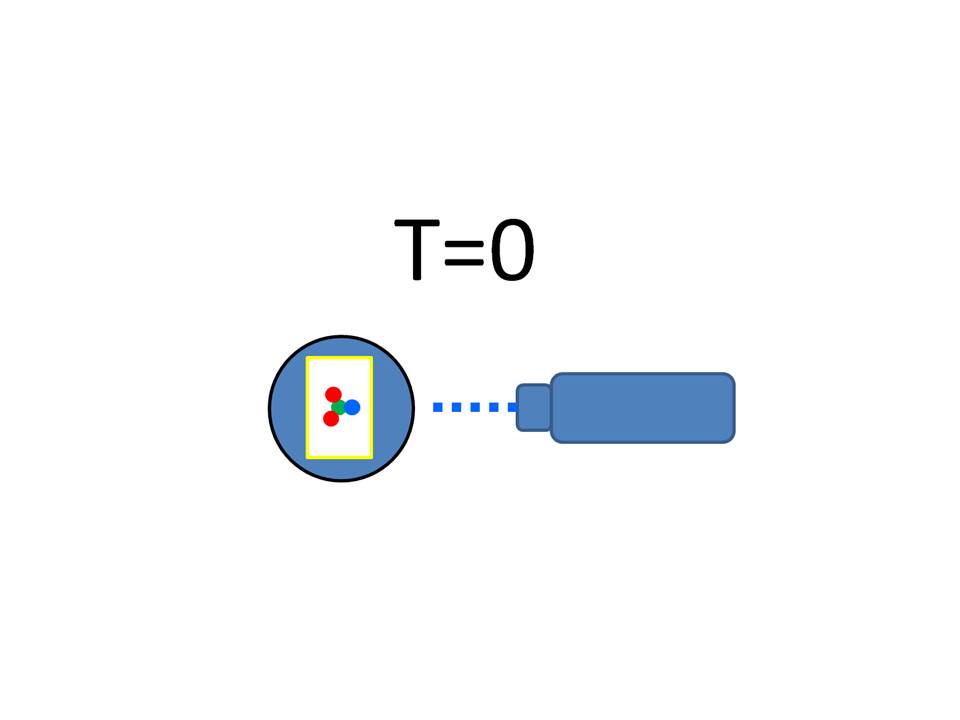
Upon entering the entangled |Ψ⁺⟩ Bell state, the 810nm pair’s polarization basis is established along a ‘hidden basis’. This is a real polarization basis in superposition to all polarization bases accessible to contemporary measuring devices within the coherent reference frame participatory masses including the BBO crystal and we share. The hidden basis will be reconciled with our reference frame when the Bell state decoheres through measurement.
At T=0.5 the arbitrarily designated ‘idler’ member of the pair encounters a reflective linear polarizer. A reflective linear polarizer is one of several devices capable of implementing a unitary transformation. A unitary transformation is a reversible transformation which preserves coherence, maintaining both superposition and entanglement.
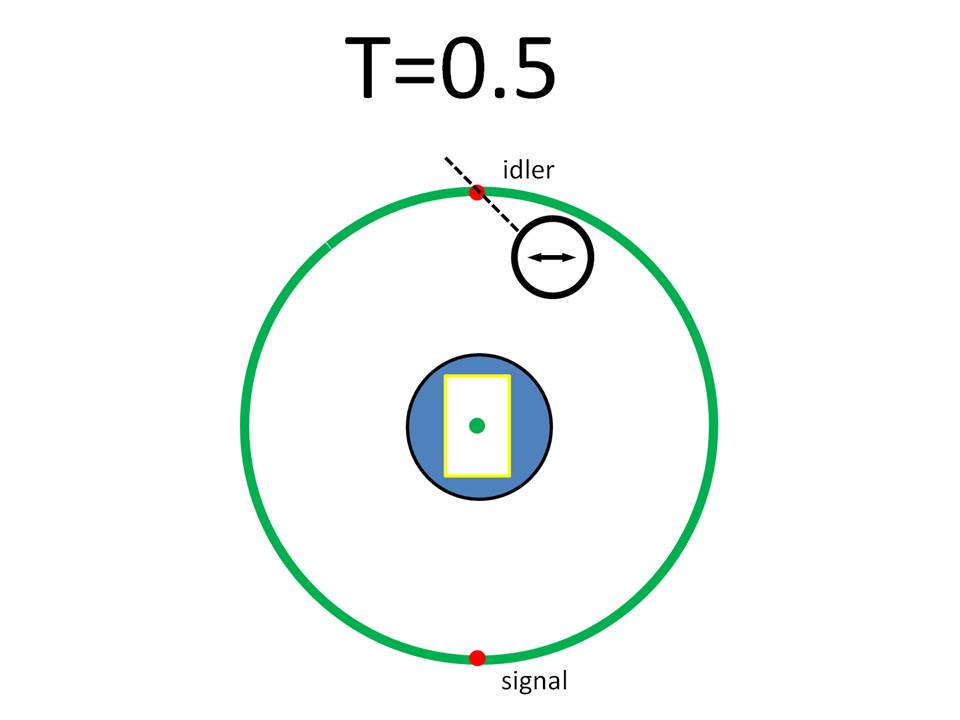
After encountering the reflective linear polarizer the idler photon enters a state of superposition with itself, travelling as both a reflected (vertically polarized; 50%) and transmitted (horizontally polarized; 50%) wave.
At T=1 measurement of the idler photon occurs. Measurement in this case involves detecting the idler photon at either charge coupled detector i1 or i2. Measurement in general is the meaningful exchange of information with a mass participating in the coherent reference frame we share. The information exchanged is the hidden basis correlation to the linear polarization selected as the T=0.5 unitary transformation. The disclosure of this information at T=1 marks the exit (decoherence) of the entangled photon pair from the Bell state.
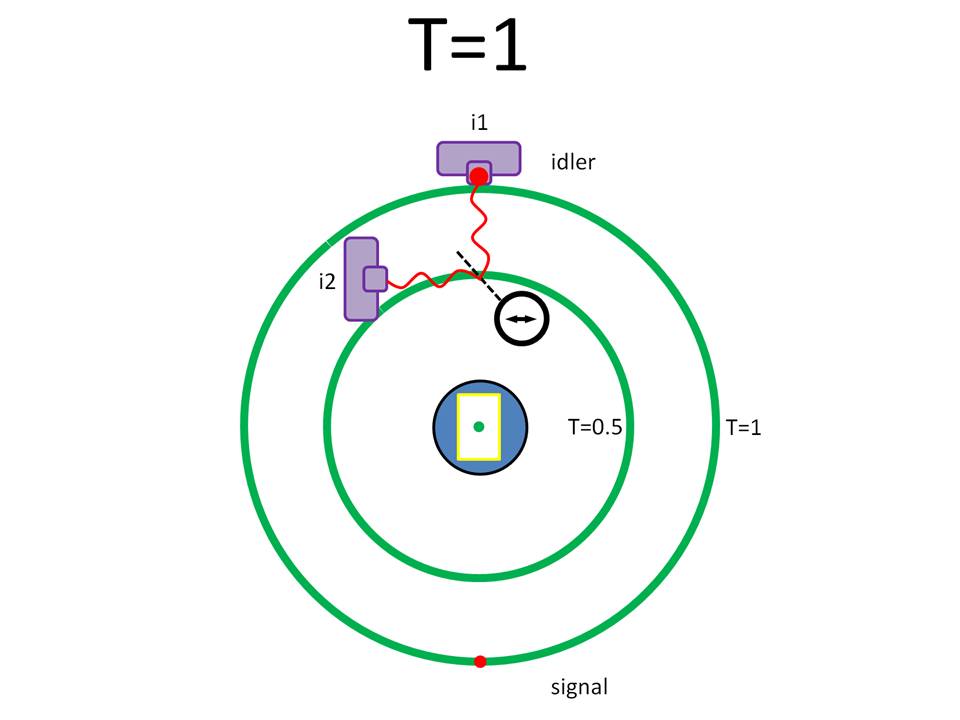
For any polarization basis selected at T=0.5, there is a 50% chance of detecting the idler photon at i1 and a 50% chance of detecting the idler photon at i2. There is no known way to influence this unpredictable outcome (see |Ψ⁺⟩ Bell State Property 1). However, the entangled photon pair is no more. The Bell state has decohered and the hidden polarization basis of the signal photon is resolved as perpendicular to the measured polarization of the idler photon.
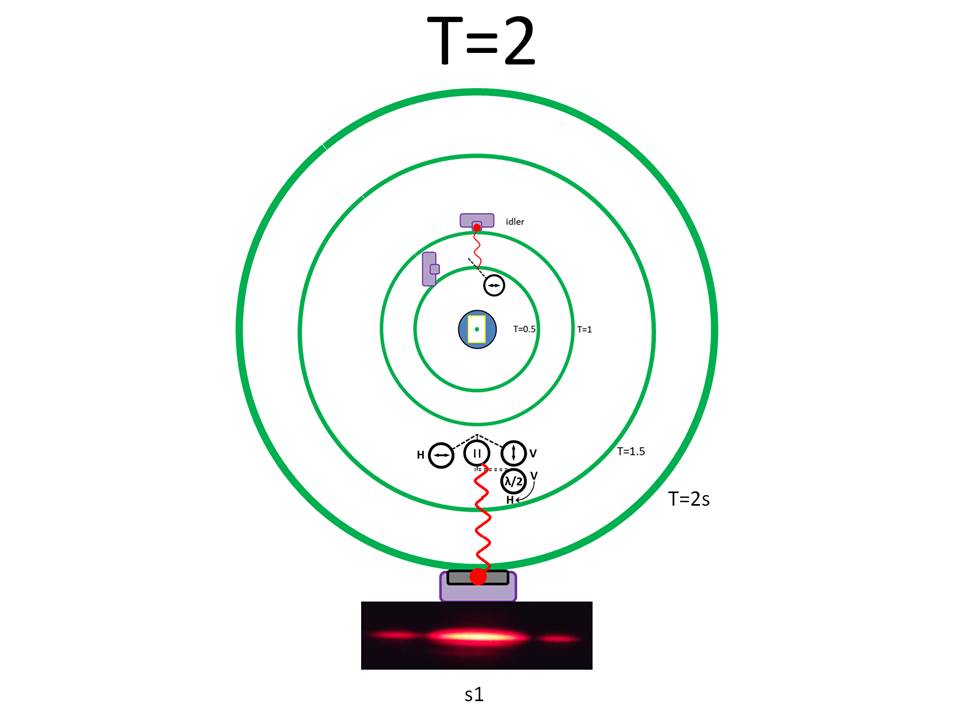
At T=1.5 the signal photon encounters a modified double slit complex designated ‘Young Inquisitor’, which introduces unitary transformations upon the signal photon, the characteristics of which are described in Double Slit Property 3. At T=0.5 the polarization bases of horizontal (H) and vertical (V) were set and the idler photon was measured at T=1 as either vertical H or V. Given |Ψ⁺⟩ Bell State Property 2 and establishment of H and V axes at T=0.5, the signal photon will definitely travel through one slit or the other at T=1.5, but not both.
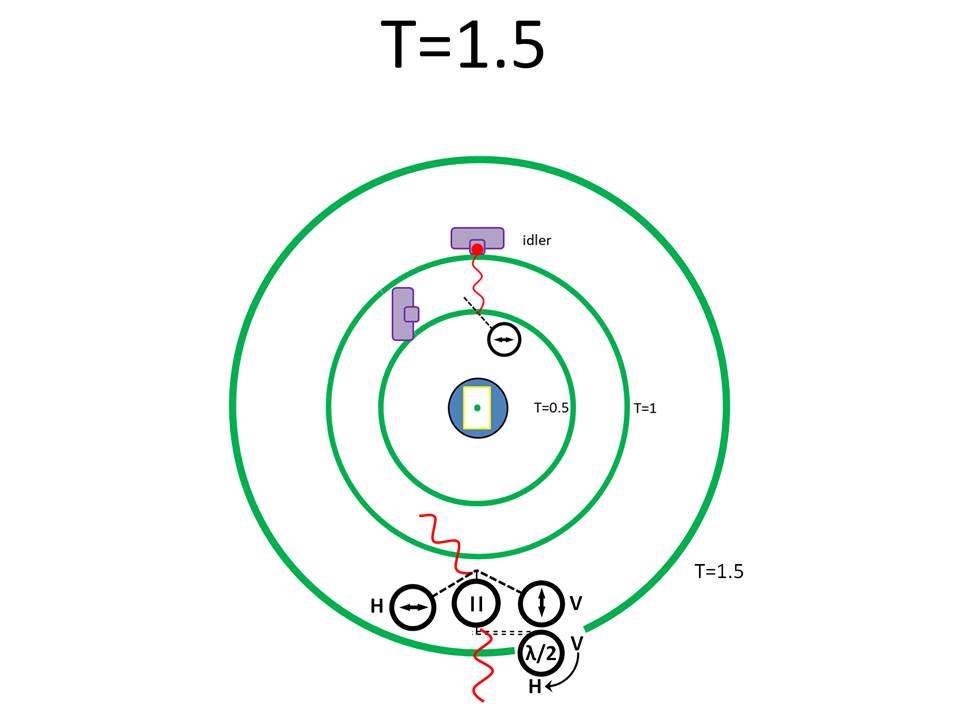
At T=2 the signal photon position is measured using a charge coupled device. The signal photon traveled through one slit or the other, but not both. After collection of several photons at detector s1 a single slit interference pattern will emerge.
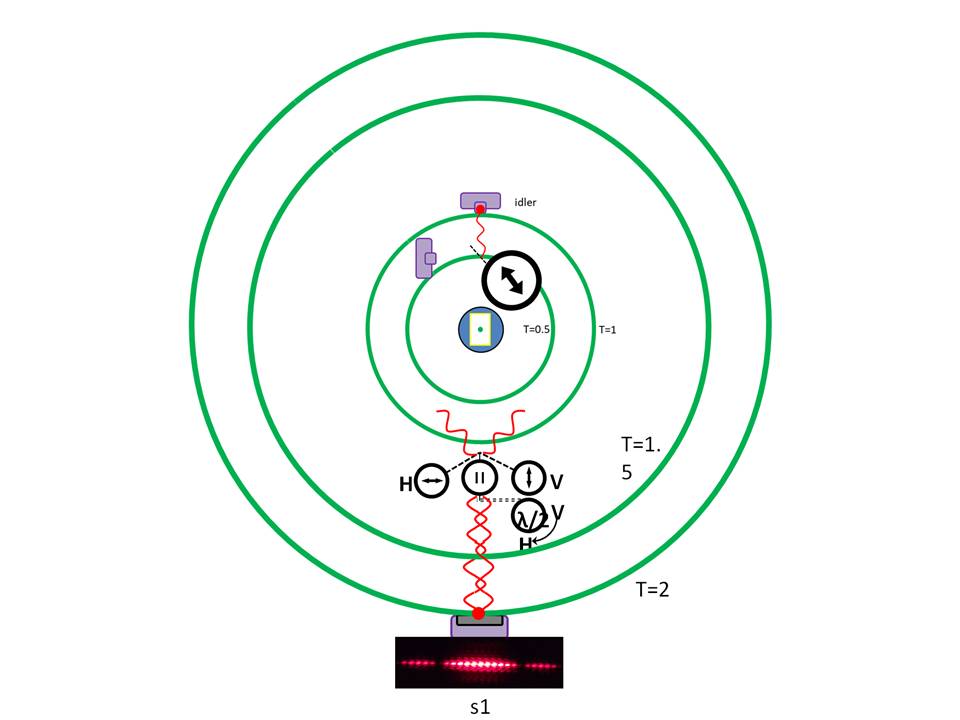
However, if at T=0.5 the +/-45⁰ basis is applied to the idler and at T=1 the idler is measured at either i1 or i2, the polarization of the signal photon is set along this +/-45⁰ axis. If idler is measured +45⁰, then signal must be -45⁰. If idler is measured -45⁰, then signal must be +45⁰. If the signal photon is +/-45⁰, then when it undergoes unitary transformation by the Young Inquisitor it enters a state of superposition with itself whereby the wave function traverses both slits (See Double Slit Property 3). Each signal photon will interfere with itself. After collection of several photons at detector s1 a double slit interference pattern will emerge.
By alternating the orientation of the linear polarizer on the idler arm at T=0.5 between H and +45⁰ a signal of either a single slit interference pattern or double slit interference pattern can be transmitted to the signal arm detector.
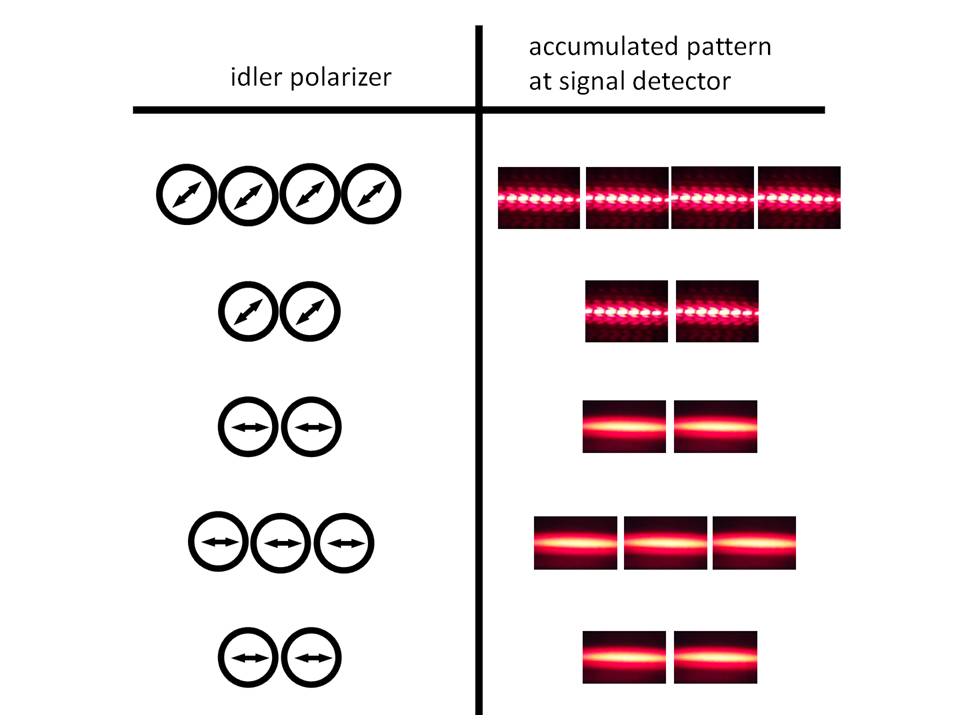
Using the above protocol, information can be transmitted from the idler arm to the signal arm by selecting the polarization basis (H/V or +45⁰/-45⁰) for |Ψ⁺⟩ Bell state decoherence correlation. Various methods such as spooled fiber for terrestrial idler delays or reflective satellite relays for interplanetary communication scale idler delays can be employed for picosecond calibrated hidden basis FTL communication systems. This allows for near-instantaneous communication across any distance with an established hidden-basis communication laser link.